Burma (officially Myanmar from June 18, 1989, in English Burma), is a country in Southeast Asia. It occupies the western coast of the Indochinese peninsula, overlooking the Bay of Bengal and the Andaman Sea and is bordered from west to east with Bangladesh, India, China, Laos and Thailand. Currently, after the coup of 1988, under the military regime of Than Shwe. Burma is one of the countries in the developing world. It has a population of about 51 million inhabitants, but the last reliable census was conducted in 1984. On 27 March 2006, the junta moved the capital from Yangon to Pyinmana, which was officially renamed "Naypyidaw", or "seat of kings".
GEOGRAPHY
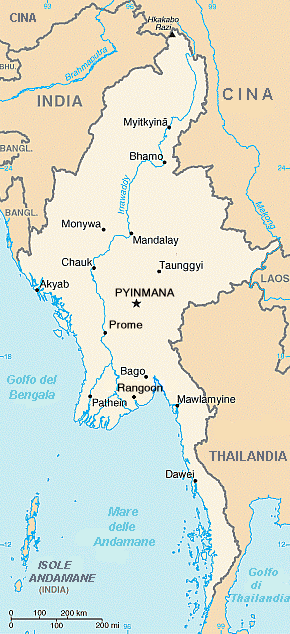 with China and east with Thailand and Laos. It's big 678,500 sq km and is the largest state in Peninsular Indochina, but not the regional one (that title belongs to Indonesia). It is twice the size of Italy, slightly larger and slightly less in Afghanistan in Zambia. It is crossed by the Tropic of Cancer.
 The territory can be divided into five parts from the physical point of view: the mountains of northern, western, eastern plateau, the central basin and the coastal area. In the north the peaks are steep and high and plug directly into the Himalayas, forming the ultimate spur. In the area Western chains are rather lower. To the east lies the Shan Plateau, arid wasteland in the northern part, rich in tropical forests in the south. To the west the plateau drops sheer to the south as it extends into mountains that form the coast of Tenasserim. The coastal area proceeding from north to south has high and rugged coastline, bathed in the Bay of Bengal, followed by the Irrawaddy delta and the coastal plains bordering the Gulf of Martaban. Finally, in the southern part ridivengono high and rocky coasts.
ECONOMICS
The official currency is the Kyat (to November 6, 2006, 1 € = 810.47 kyat). Represented on all denominations of paper money the "chintzed", the traditional statue. The other paper money values \u200b\u200bare 5, 10, 50, 100, 200, 500 and 1000 Kyats. Burma is one of the poorest nations in the world, because in recent history there have been economic stagnation, mismanagement and isolation. The gross domestic product of Burma is growing annually by only 2.9% (the lowest rate in the region). Since 1948, after the establishment of the first military government, Prime Minister U Nu attempted to make Burma a country rich enough. The coup in 1962 was followed by a socialist economic model, a program to check all state companies, with the exception of agriculture. In 1989, the Burmese government began to decentralize economic control. Since then it has started to liberalize certain sectors of the economy. The lucrative industries of gems, oil processing and forestry are still strictly regulated. Have recently been exploited by foreign companies that have partnered with the government to access the natural resources of Myanmar. Under the British administration, Burma was one of the richest colonies. It was the largest exporter in the world of rice and oil supplied by Burman Oil Company. Produces 75% of the teak in the world and the country believed the fastest way to development. Today, Burma has insufficient infrastructure. Goods travel primarily across the Thai-Burmese border, where most part of the illegal drugs are exported. A major "highway" is the Irrawaddy River. The railways are old and rudimentary, with few repairs since their construction in the nineteenth century. The main roads are usually not paved, except in major cities.
INTERNAL POLICY
The Union of Myanmar is ruled by a military regime. Elected in 1990, formed the Popular Assembly of the National Coalition for the Administration of the Union of Burma (NCGUB), which is now in exile and work for democracy in the state led by Sein Win, a cousin of Aung San Suu Kyi. However, the NCGUB has few powers and is banned in Burma. The current head of state, General Than Shwe, who holds the title of head of state council of peace, has all powers, including the right to remove ministers and their members, take the major decisions in terms of foreign policy. Khin Nyunt was prime minister until 19 October 2004, replaced by General Soe Win, who cut many powers to Than Shwe. Most ministries are headed by army officers, with the exceptions of the Ministry of Health, Ministry of Education and the Ministry of Labour, which are in the hands of civilians. The major political parties in Burma are the National League for Democracy and the Shan Democratic League, even if their activities are regulated by the regime. There are many other parties, representatives often the interests of ethnic minorities. There is little tolerance for 'political opposition and many political parties were proscribed. The party National Unity is the military and is supported by totalitarian organization called the Association for Solidarity and Development of the Syndicate. According to several organizations, including Amnesty International, the regime has little regard for human rights. There is no independent judiciary in Myanmar
 and political opposition to the military government is not tolerated. In 1989, the Burmese army violently repressed protests against economic mismanagement and political oppression. The bloodiest incident occurred on August 8 1988 when the military opened fire on rioters in what is known as directed 88. Despite the failures of the riots, the protests of 1988 have paved the way for the People's Assembly elections in 1990. The election results were later invalidated by the regime. The National League for Democracy led by Aung San Suu Kyi, won more than 60% of the votes and more than 80% of parliamentary seats in the election in 1990, held for the first time in 30 years. Aung San Suu Kyi has earned international praise as an activist for the return of democratic government in Burma, won the Nobel Peace Prize in 1991. She was sentenced to house arrest. The situation in Burma was reported to the UN Security Council for the first time in December 2005 for an informal consultation. ASEAN has also stated its frustration with the government of Burma. He formed the Inter-Parliamentary Committee to address the lack of democracy in Burma. A radical change in the political situation remains unlikely, due to the support provided by neighbors influence, in particular China. However, progress is being made to democratize the country.
 FOREIGN POLICY The foreign relations of Burma are quite difficult. The United States has imposed sanctions because of the severe and illiberal way of ruling military regime established in 1988. Many economic penalties were caused by the repression of protests in the same year by instabilities that lead to ethnic conflict between the government and the Karen and the Shan and the almost total lack of democracy. The European Union has cut off trade with the state and has removed any financial aid, except humanitarian one. The U.S. and European sanctions against the military regime and the pressures of democratic Burma, have forced many Western companies to leave Burma. Asian societies, however, have decided to continue to invest there and open up new companies, mainly based on the extraction of natural gas. ASEAN will not defend Burma in any international conference resulting in a denial of military regime to restore democracy. In April 2007 the Minister Ahmad Shabery Cheek Malaysian Foreign said that neither his state, nor ASEAN would help the country and said, "Now Myanmar has to defend itself if it is involved in a discussion in any World Conference" . He was responding to opposition leader Lim Kit Siang. Lim said that Malaysia should play a productive role in regional initiatives aimed at bringing change to Burma and to note the situation of the state to the UN Security Council.
Pergamon Journal of Earth Observing 

0 comments:
Post a Comment